


Dog and itching: causes, symptoms and solutions to relieve your dog
Health Guide · Skin & Coat
Dog Itching: Causes, Symptoms, and Solutions to Relieve Your Dog
Is your dog constantly scratching, licking, or biting themselves? Here’s how to understand the cause of their itching, when to see a vet, and how to help them every day.
🩺 The Essentials in 30 Seconds
- The 3 main causes of itching in dogs: parasites (fleas are the leading cause), allergies (environmental or food-related), and skin infections.
- The area that itches is a clue: the lower back for fleas, the paws and belly for allergies, and the ears for ear infections.
- See a vet promptly if you notice wounds, scabs, hair loss, odors, or scratching that prevents your dog from sleeping.
- Every day: keep parasite prevention up to date, use gentle care products, and use a course of dietary supplements to support the skin barrier from within.
Why Does My Dog Itch?
Scratching from time to time is completely normal behavior in dogs. But when scratching becomes frequent or intense, or is accompanied by repeated licking, biting, or redness, it is called pruritus: an itchy sensation that indicates something is wrong with the skin.
Pruritus is one of the most common reasons for a veterinary visit. It is not a disease in itself, but a symptom with multiple, often combined, causes. Identifying them is the first step toward providing your companion with lasting relief.
Where Does Dog Itching Come From?
1. Parasites: The First Cause to Rule Out
These are the most common culprits and the first things to check:
- Fleas: some dogs develop an allergy to flea saliva (flea bite hypersensitivity or flea allergy dermatitis). A single bite can be enough to trigger intense itching, especially on the lower back and at the base of the tail.
- Mange mites (sarcoptic mange), which cause intense scratching, often around the ears, elbows, and belly. It is contagious and requires veterinary treatment.
- Fleabirds (late summer, early autumn), which nestle between the toes, on the belly, or around the eyes.
2. Allergies
- Atopic dermatitis: sensitivity to environmental allergens (pollen, dust mites, mold). It often appears in young dogs and typically affects the paws, belly, armpits, and face.
- Food allergy or intolerance: certain proteins, such as chicken or beef, are frequently to blame. Itching is then present all year round, sometimes associated with digestive problems or recurring ear infections.
- Contact allergy: to household products, unsuitable shampoo, certain plants, or materials.
3. Skin Infections
Bacteria (pyoderma) or yeast (Malassezia) often take advantage of skin already weakened by scratching. They perpetuate a vicious cycle: the dog scratches, damages its skin, which becomes infected and itches even more. An unusual odor, bumps, scabs, or greasy skin should be a cause for concern.
4. Dry Skin or a Weakened Skin Barrier
Winter heating, bathing too frequently, harsh shampoos, or essential fatty acid deficiency (omega 3 and 6): the skin loses its moisture, cracks, and allows irritants to penetrate more easily. Dandruff and dull fur then appear.
5. Other Causes
More rarely, itching can be linked to a hormonal imbalance, stress, or boredom (compulsive paw licking), or even an imbalance in the intestinal microbiota, which is increasingly studied for its link to skin health.
Where Does Your Dog Scratch? What the Area May Indicate
| Scratching Area | Common Clues |
|---|---|
| Lower back, base of the tail | Fleas, flea bite hypersensitivity |
| Paws, between the toes | Atopic dermatitis, food allergy, fleabirds, boredom |
| Belly, armpits, groin | Allergies, contact allergy |
| Ears | Ear infection, food allergy, mange |
| Face, around the eyes and muzzle | Atopic dermatitis, food allergy |
| Whole body | Dry skin, mange, generalized infection |
These indications are clues, not a diagnosis: only your veterinarian can identify the cause with certainty.
⚠️ When to see a veterinarian?
Make an appointment without delay if you notice:
- wounds, scabs, bumps, or a red, oozing area (hot spot);
- localized or widespread hair loss;
- a bad odor from the skin or ears;
- scratching that prevents your dog from sleeping or eating normally;
- itching that lasts more than a few days despite up-to-date parasite prevention;
- associated digestive problems (vomiting, loose stools).
The veterinarian can perform tests (skin scraping, cytology, an elimination diet…) and prescribe a suitable treatment if necessary. Itching medications are available by prescription only.
How to relieve your dog’s itching?
In addition to seeking veterinary advice, several simple steps can help your dog regain comfort every day.
1. Keep parasite prevention up to date
This is essential, even if you don’t see any fleas: treat your dog, other pets in the household, and the environment (beds, rugs, sofas). Strictly follow the frequency indicated on the product.
2. Use gentle care products
Use a special shampoo for sensitive skin, with a pH suitable for dogs and without harsh fragrances. Rinse thoroughly and dry well, especially between the toes. After a walk during pollen season, simply rinsing the paws and belly can limit contact with allergens.
3. Review their diet
If a food allergy is suspected, your veterinarian may recommend an elimination diet for several weeks, using a protein your dog has never had (or has had very little) before. Also check the ingredients of treats and supplements, which often contain chicken.
4. Nourish the skin from within with a suitable supplement
Since itching often has multiple causes, a multi-active dietary supplement given as a course over several months can support the skin on all fronts: the skin barrier, hydration, and microbiota.
💚 OUR RECOMMENDATION

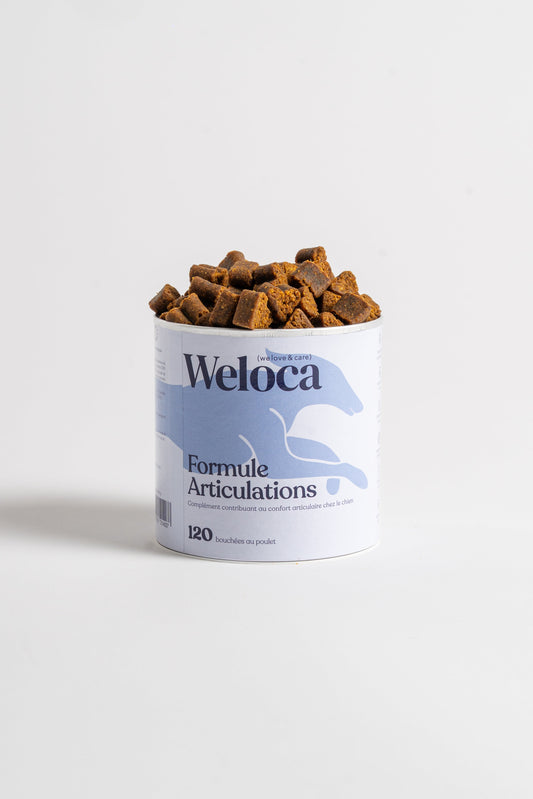
Weloca fish-based itching supplement
Formulated with our partner veterinarian, it contains 16 nutrients chosen to support dogs with sensitive skin:
- Fish base (23.5%), chicken-free: an interesting alternative if diet is a factor.
- Omega 3 and 6 (fish, evening primrose, and red raspberry oils), which help maintain the skin barrier.
- Chelated zinc, vitamins C and E, involved in skin renewal.
- Probiotics and prebiotics to support a balanced microbiota.
120 tasty bites per jar, providing a course of treatment for up to 4 months. The dose (1 to 6 bites per day, depending on weight) is given once in the morning for at least 3 months. French brand, rated 4.7/5.
Discover the supplement →👉 Not sure which product to choose? See our comparison of over-the-counter anti-itching products for dogs.
5. Use a topical treatment for immediate relief
The supplement works over time from within. For irritated areas, a soothing topical treatment provides faster relief. The two approaches complement each other.

6. Break the vicious cycle of scratching
If your dog is obsessively scratching an area, a cone or protective bodysuit can prevent them from worsening the lesions. Keep them more entertained too (walks, sniffing games, chewing): boredom and stress often increase licking.
What not to do
- Give a human medication (antihistamine, anti-inflammatory, or corticosteroid cream) without consulting your veterinarian.
- Apply pure essential oils to the skin: many are irritating or even toxic to dogs.
- Bathing too often with unsuitable products, which dry out the skin even more.
How to prevent itching?
- Year-round parasite control, not just in summer.
- Regular brushing to aerate the coat and spot redness or parasites early.
- High-quality food, rich in essential fatty acids.
- Preventive supplements to support your dog's skin if they are prone to itching.
- Healthy environment: wash the bed and blankets regularly at high temperatures.
FAQ: itching in dogs
My dog scratches but doesn't have fleas, why?
Fleas are often difficult to see, and a single bite is enough for an allergic dog. If parasite protection is up to date, the following possibilities include allergies (environmental or food), dry skin, or a skin infection. A veterinary consultation will help clarify.
Is it normal for a dog to scratch?
Yes, occasionally. It becomes concerning when it is frequent, intense, focused on one area, or leaves traces: redness, sores, hair loss, or constant paw licking.
Why does my dog lick its paws?
Paw licking is a classic sign of atopic dermatitis or a food allergy. It can also indicate boredom, stress, irritation between the toes (foxtails, grass awns), or pain.
Can diet cause itching?
Yes. Certain proteins, such as chicken or beef, are frequently associated with food reactions in dogs. In such cases, itching is present all year round. The diagnosis is based on an elimination diet lasting several weeks, conducted with your veterinarian.
How long does it take to see an improvement?
It depends on the cause. Parasite treatment works within a few days, but a dietary supplement requires 2 to 3 months of regular intake to allow the skin to renew. Weloca recommends a minimum 3-month course.
Is itching in dogs contagious?
Allergies and dry skin are not contagious. However, fleas and sarcoptic mange can spread to other animals in the household, and mange can sometimes be transmitted to humans. This is why it is important to treat all animals and the environment.
In summary
Your dog's itching is a signal that should not be ignored. First, rule out parasites, consult a veterinarian in case of lesions, and then focus on a comprehensive approach: gentle care, a suitable diet, and a supplement course to support their skin from within. With consistency, your companion can regain true daily comfort.
Start the Weloca course →




 Money-back guarantee


