


My dog scratches a lot: what should I do? The step-by-step guide
Practical Guide · Skin & Coat
My dog scratches a lot: what should I do? The step-by-step guide
Your dog is scratching more than usual and you don't know where to start? Follow our checklist to understand what is happening and act at the right time.
🩺 The essentials in 30 seconds
- “A lot” means when scratching becomes daily, wakes your dog up at night or leaves marks on the skin.
- Today: inspect the skin and check the antiparasitic treatment.
- This week: observe, take notes and consult if it does not improve or if lesions appear.
- Over 3 months: focus on gentle care, a suitable diet and a course of supplements to support the skin from within.
When does a dog scratch “a lot”?
All dogs scratch: upon waking up, after a walk, rolling around in the grass. This occasional scratching is part of their grooming. What should alert you is not the action itself but its frequency, its intensity and its consequences.
Your dog is probably scratching too much if:
- he scratches several times an hour, every day;
- he stops in the middle of an activity (meal, play, walk) to scratch;
- the sound of scratching wakes you up at night;
- he licks or bites himself in addition to scratching;
- you see redness, thinning hair or small wounds.
The checklist: 5 questions to understand why your dog scratches
Before looking for a solution, take a few minutes to answer these questions. They will guide you, and will be very useful to your veterinarian if you consult.
1. Is his antiparasitic treatment up to date?
If the answer is no, or “I don’t know anymore,” that’s clue no. 1. Fleas are often invisible, and a single bite is enough to cause severe itching in an allergic dog. Look for small black dots in the coat: placed on damp paper, they turn reddish.
2. Where does he scratch?
Lower back and base of the tail: think about fleas. Paws, belly, armpits, face: think about allergies. Ears: think about an ear infection. Everywhere: dry skin or mange.
3. Since when, and in which season?
Scratching that returns every spring or every summer suggests an environmental allergy (pollen, grasses). Scratching present all year round points more towards diet, house dust mites or chronically dry skin. A sudden onset makes you think of parasites or irritating contact.
4. Has something changed recently?
New kibble or treats, new shampoo, new laundry detergent, moving house, staying at a kennel, arrival of another animal… A recent change is often the trigger.
5. Does the skin show lesions?
Redness, bumps, scabs, dandruff, hair loss, odor, damp area: the more damaged the skin is, the more important it is to consult quickly.
The most common causes
| Cause | Typical signs | First reflex |
|---|---|---|
| Fleas | Scratching the lower back, small black dots | Antiparasitic treatment for all pets + home |
| Environmental allergy | Paws, belly, face; often seasonal | Rinse paws and belly after the walk |
| Food reaction | All year round, ear infections, sometimes digestive issues | Elimination diet with the veterinarian |
| Dry skin | Dandruff, dull coat, especially in winter | Space out baths, provide omega 3/6 |
| Skin infection | Bumps, scabs, odor, greasy skin | Consult the veterinarian |
| Mange | Very intense scratching, ears, elbows | Consult the veterinarian (contagious) |
| Stress, boredom | Licking paws, especially alone at home | More activity and stimulation |
My dog scratches a lot: the action plan
📅 Today
- Inspect the skin by parting the hair, especially on the lower back, belly, paws and ears.
- Check the date of the last antiparasitic treatment and renew it if necessary, for all pets in the household.
- Wash his bed and blankets at a high temperature.
📅 This week
- Note your observations: scratched areas, times of day, possible triggers. A photo of the irritated areas is very useful for the veterinarian.
- Use a gentle shampoo for sensitive skin, without bathing too often.
- Consult if the scratching does not decrease after a few days with an up-to-date antiparasitic treatment, or as soon as lesions appear.
📅 Over the next 3 months
Recurring itching rarely has a single cause. To regain lasting comfort, you need to work on the quality of the skin itself: its protective barrier, its hydration, and the balance of the microbiota which plays an increasingly studied role in skin health. This is where a long-term course of supplements makes all the sense.
💚 OUR RECOMMENDATION

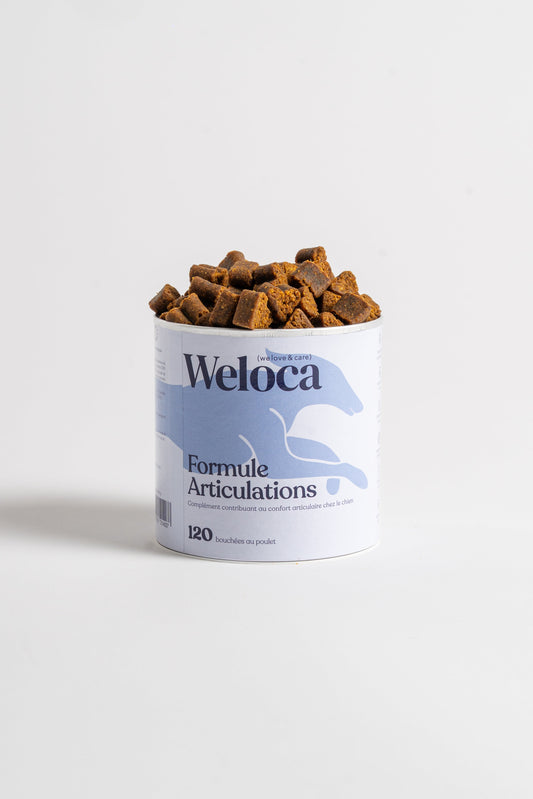
The Weloca fish itching supplement
Formulated with our partner veterinarian for dogs that scratch a lot, it brings together 16 nutrients:
- Omega 3 and 6 (fish, evening primrose and borage oils), which contribute to maintaining the skin barrier.
- Chelated zinc, vitamins C and E, involved in skin renewal.
- Fish base (23.5 %), without chicken: an interesting alternative if diet plays a role.
- Probiotics and prebiotics to support the balance of the microbiota.
120 tasty bites per pot, which is a course of up to 4 months. The dose (from 1 to 6 bites per day depending on weight) is given once in the morning, for a minimum of 3 months. French brand, rating of 4.7/5.
Discover the supplement →

- Keep an antiparasitic treatment all year round, not just in summer.
- Brush your dog regularly to spot redness early.
- Give him enough activity: a dog who is bored tends to lick and scratch more.
⚠️ The signs that should make you consult without delay
- wounds, scabs, bleeding or red and damp area;
- significant hair loss;
- bad odor from the skin or ears;
- scratching that prevents your dog from sleeping;
- fatigue, loss of appetite, vomiting or diarrhea associated;
- puppy or older dog that suddenly starts scratching a lot.
Never give your dog human medication (antihistamines, cortisone) without veterinary advice: medications for itching in dogs are available by prescription.
👉 Learn more: dog scratching and biting itself · comparison of over-the-counter anti-itch products
FAQ: my dog scratches a lot
My dog scratches a lot but doesn't have fleas. Why?
Fleas are often invisible, especially if your dog grooms itself a lot. If its parasite treatment is up to date, consider allergies (environmental or food), dry skin, an infection, or stress.
My dog scratches a lot at night. Is it serious?
Scratching that disrupts sleep indicates intense itching. It's not necessarily serious, but it's a good sign to consult a vet: a dog that sleeps poorly does not recover well and often becomes more irritable.
Why does my dog scratch more in winter?
Heating dries out the air and therefore the skin. Dust mites are also more prevalent indoors. Bathe less often, humidify the room if possible, and consider omega 3 and 6 to nourish the skin.
My puppy scratches a lot. What should I do?
In puppies, parasites (fleas, mites) are the most common cause. Check with your vet that the parasite treatment is suitable for its age and weight. Atopic dermatitis can also appear in the first few months.
Can changing kibble help?
Yes, if a food reaction is involved. But changing brands is not always enough: you need a different protein, ideally as part of an elimination diet lasting several weeks and monitored by your vet.
How long before you see a difference?
A parasite treatment works in a few days. For a dietary supplement, allow 2 to 3 months of regular intake, enough time for the skin to renew. Weloca recommends a minimum 3-month course, taken continuously.
In summary
If your dog scratches a lot, start with the essentials: inspect its skin and update its parasite treatment. Observe it for a few days, consult a vet in case of lesions, then establish a long-term routine: gentle care, suitable nutrition, and a supplement course to support its skin from within.
Start the Weloca course →




 Money-back guarantee


