


Dog scratching and biting itself: symptoms, causes and solutions
Health Guide · Behavior & Skin
Dog Biting and Chewing Itself: Symptoms, Causes, and Solutions
Paws, tail, flanks, hindquarters… When a dog bites and chews itself in addition to scratching, it is never trivial. Here is how to decipher its behavior and help it on a daily basis.
🩺 The essentials in 30 seconds
- Biting and chewing is often an "intensified" scratch: the dog uses its teeth when its paws are no longer enough to soothe the itch.
- The bitten area points to the cause: base of the tail for fleas, paws for allergies, hindquarters for anal glands.
- Watch out for hot spots: a red, moist, hairless area can appear in a few hours and must be seen by a veterinarian.
- The solution involves 3 areas: treat the cause, protect the damaged skin, and support the skin barrier from within.
Why does my dog scratch and bite itself?
A dog that scratches from time to time is normal. But a dog that scratches and bites its paws, tail, or flanks is sending a stronger message: the sensation is intense enough that it needs its teeth to soothe it.
This biting can have a skin origin (parasites, allergies, infection), physical (pain, foreign body), or behavioral (stress, boredom). Very often, these factors intertwine: an itch triggers the biting, which damages the skin, which itches even more. The goal is to break this vicious cycle.
Symptoms to watch for
Beyond the scratching itself, observe your dog carefully. These signs will help you, as well as your veterinarian, to guide the diagnosis:
- Repeated biting of the same area, sometimes with small "nibbling" movements of the incisors.
- Persistent licking, especially of the paws, with hair that turns reddish-brown due to saliva.
- Redness, bumps, scabs or small wounds.
- Localized hair loss or broken, sparse hair.
- Hot spot: a red, moist, hot, and painful patch that spreads quickly.
- Unusual odor from the skin, paws, or ears.
- Behavioral change: agitation, disturbed sleep, irritability.
What does the area your dog bites reveal?
| Bitten area | Common causes | Additional clue |
|---|---|---|
| Base of the tail, lower back | Fleas, flea bite allergy | Small black specks in the coat |
| Paws, between the toes | Atopic dermatitis, food allergy, flea allergy dermatitis, grass awn | Reddish hair, yeast odor |
| Hindquarters, around the anus | Congested anal glands, worms, fleas | The dog "scootches" on its butt |
| Flanks, thighs | Allergies, hot spot, dry skin | Moist and hot patch |
| A joint (knee, wrist) | Joint pain | Stiffness upon waking, limping |
| Always the same paw, without a lesion | Stress, boredom, compulsive licking | Especially when the dog is alone |
These indications are clues, not a diagnosis: only your veterinarian can identify the cause with certainty.
The most common causes
1. Fleas and other parasites
This is the number one cause, especially when the dog bites the base of its tail. In a dog allergic to flea saliva, a single bite can trigger several days of itching. Flea allergy dermatitis, at the end of summer, targets the paws and belly, while mange causes very intense scratching and must be treated by a veterinarian.
2. Environmental and food allergies
Atopic dermatitis (pollen, mites, mold) and food reactions typically manifest as biting and licking of the paws. If the symptoms are seasonal, the environment is the primary suspect; if they last all year, food is more likely. Certain proteins like chicken are frequently involved.
3. Infections and hot spots
From being bitten and licked repeatedly, the skin becomes damaged and becomes an entry point for bacteria and yeast. This is how hot spots (pyotraumatic dermatitis) are born: red, oozing, and painful patches that can spread in a few hours. They are common in long-haired or thick-coated dogs, especially in hot and humid weather.
4. Anal glands
If your dog bites its hindquarters, suddenly turns toward its tail, or rubs its butt on the ground, its anal glands may be congested. An expression by the veterinarian generally solves the problem.
5. Pain or a foreign body
A dog can bite a painful area, such as an arthritic joint, or a paw in which a grass awn has lodged. In this case, the biting is often very localized and the skin may look normal at first.
6. Stress and boredom
Biting and licking have a soothing effect. A dog that is bored, stays alone for long periods, or experiences a change (moving house, the arrival of a baby or another animal) can develop compulsive licking. Warning: biting of behavioral origin can end up creating real lesions, which then perpetuate the itching.
⚠️ When to see a veterinarian?
- A red and moist patch appears (hot spot);
- your dog bleeds, has scabs, or loses its hair;
- it bites relentlessly, even at night;
- it limps, or always bites the same joint;
- it repeatedly rubs its butt on the ground;
- the problem persists for more than a few days despite an up-to-date antiparasitic.
Solutions: how to soothe a dog that scratches and bites itself?
1. Inspect the area
Move the hair aside and look closely: fleas or their droppings (small black specks that turn red on damp paper), grass awn between the toes, redness, wound. Note the area, the time of day, and the season: this information will be valuable for your veterinarian.
2. Treat for parasites
Update the antiparasitic treatment for all animals in the household and treat the environment (bed, rug, sofa). This is essential, even if you do not see any fleas.
3. Protect the damaged skin
To break the vicious cycle, prevent your dog from reaching the area: cone, protective bodysuit, or sock for the paws. Clean gently with a product suitable for dogs and apply a soothing local treatment if your veterinarian approves.
4. Support the skin from within
Itching skin is often skin whose barrier is weakened. A food supplement rich in essential fatty acids, zinc, and vitamins, given as a long-term course, helps strengthen this natural protection and limit recurrences.
💚 OUR RECOMMENDATION

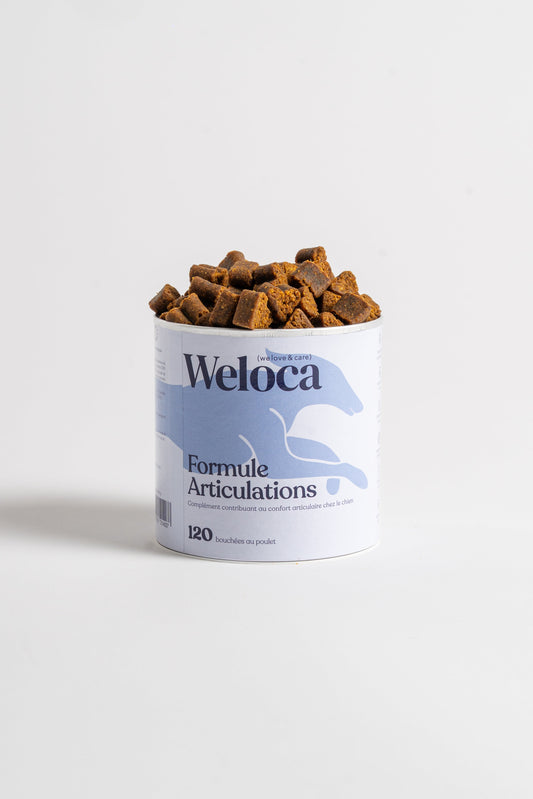
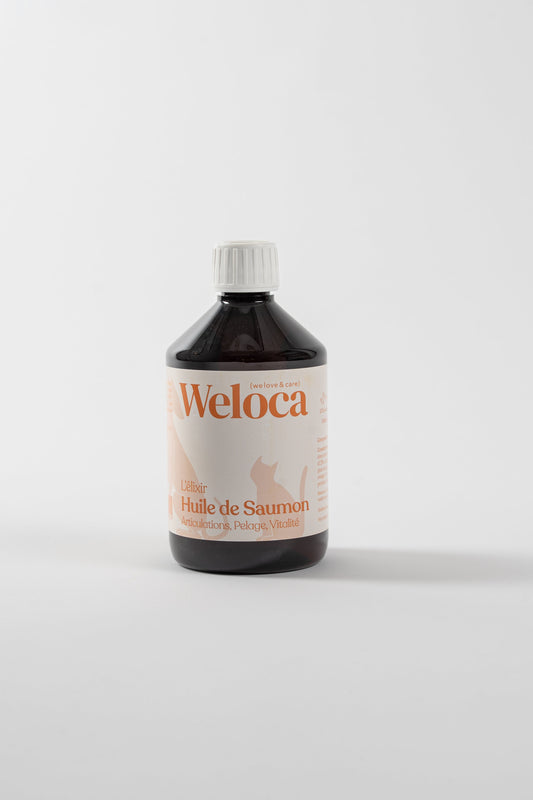
The Weloca fish itching supplement
Formulated with our partner veterinarian, it combines 16 nutrients to support dogs that scratch and bite themselves:
- Omega 3 and 6 (fish, evening primrose, and borage oils) which contribute to maintaining the skin barrier.
- Chelated zinc, vitamins C and E, involved in skin renewal.
- Fish base (23.5 %), without chicken, if food is the cause.
- Probiotics and prebiotics to support the balance of the microbiota.
120 tasty bites per pot, which is a course of up to 4 months, easy to give even to difficult dogs. Recommended course of at least 3 months. French brand, rating of 4.7/5.
Discover the supplement →
5. Keep your dog busy
If stress or boredom play a role, increase walks, offer sniffing games, lick mats, or chew toys. A dog that is physically and mentally tired is less likely to focus on its body.
6. What to Avoid
- Scolding your dog: this increases its stress without addressing the cause.
- Giving a human medication or applying a corticosteroid cream without veterinary advice.
- Using pure essential oils, which are often irritating and sometimes toxic to dogs.
👉 To learn more, read our complete guide to dog itching and our comparison of over-the-counter anti-itch products.
FAQ: Dog Biting and Licking Its Paws
My dog bites its paws. Is it serious?
Not necessarily, but it should not be ignored. Biting the paws is a common sign of allergies (environmental or food), pododermatitis, or grass awns. Inspect the spaces between the toes and consult a vet if it persists or if the skin becomes red.
Why does my dog bite its tail?
Most often due to fleas, which target the base of the tail. Engorged anal glands and, more rarely, boredom or compulsive behavior are other possible causes.
My dog bites itself but doesn't have fleas. What should I do?
First, check that the flea treatment is up to date: fleas are often invisible. Then, consider allergies, dry skin, anal glands, or stress. A veterinarian can help determine the cause.
What is a hot spot in dogs?
It is a red, moist, hot, and painful area of skin caused by intensive licking and biting. It can spread very quickly: consult your veterinarian without delay.
Can stress cause a dog to bite itself?
Yes. Licking and biting have a soothing effect, and some anxious or bored dogs develop a real compulsive behavior. In this case, you must address both the stress and any skin lesions.
How long does it take to see an improvement with a supplement?
Allow 2 to 3 months of regular administration, enough time for the skin to renew. Weloca recommends a minimum 3-month continuous course, ideally combined with the other steps in this guide.
In summary
A dog that scratches and bites itself is trying to soothe genuine discomfort. Identify the affected area, rule out parasites, protect damaged skin, and consult a vet if lesions appear. To reduce recurrences, support its skin from within with a suitable course and provide enough activity for its well-being.
Start the Weloca course →




 Money-back guarantee


